About


The programme is designed for students who want to use economic reasoning, data, and evidence to analyse business, market, and public policy decisions and to build a long-term strategic career profile.
Organisations do not lack information. They have dashboards, reports, models, and AI-generated scenarios. What they often lack are people who can explain why outcomes happen, what value is at stake, and which decision can be defended.
Strategic Economics connects economic mechanisms, empirical evidence, and strategic decision-making. Students learn to identify the mechanism behind a problem, test assumptions with evidence, interpret value and risk, and formulate recommendations that can be explained and challenged.
Core logic: Mechanism -> Evidence -> Value -> Decision
Students apply this logic to questions of pricing, market entry, competition, regulation, productivity, innovation, and the impact of public policy.
For more information or to apply, please get in touch with the Faculty academic coordinator at:
Important admission note for non-EU/EFTA applicants: The gap since completing your Bachelor's degree must not exceed five years.
Schedule and Study Format
Strategic Economics is designed for students who want to combine Master's studies with professional and personal commitments.
Classes are typically scheduled on weekday evenings, from 5.45 to 9.00 PM Lithuanian time. During each semester, students usually study 5-6 subjects.
The Master's thesis is developed and defended in stages across the programme. This helps students move step by step from topic selection to research design, empirical analysis, interpretation, and final defence.
You Will Learn
In Strategic Economics, you learn to:
- identify economic mechanisms behind business, market, and policy problems;
- analyse incentives, competition, market power, costs, uncertainty, regulation, and value creation;
- use data and empirical evidence to test assumptions;
- connect economic theory with decision logic;
- evaluate value, risk, trade-offs, and impact;
- design decision-relevant indicators and KPIs;
- communicate recommendations clearly to academic, business, and policy audiences.
The goal is not only to know economic concepts. The goal is to use economics to explain real problems, assess alternatives, and support defensible decisions.
Examples of analytical outputs students may work on
Depending on courses, projects, data availability, and thesis choices, students may work on analytical outputs such as:
- forecasting models;
- business case analyses;
- pricing and margin assessments;
- market and competitor analyses;
- value-driver dashboards;
- policy impact memos;
- competition or regulation assessments;
- productivity diagnostics;
- decision memos.
These outputs help students demonstrate not only what they know, but how they analyse problems, use evidence, and formulate recommendations.
Study Overview
The programme combines economic theory, empirical analysis, and applied strategic problems. Students work with questions related to markets, firms, competition, regulation, innovation, pricing, productivity, finance, and public policy.
Throughout the programme, students repeatedly practise a disciplined analytical workflow:
Question -> Economic mechanisms -> Model -> Evidence -> Recommendation -> Monitoring
This workflow helps students move from broad strategic questions to structured analysis that can be explained, challenged, and improved.
Distinctive features of the programme
- Mechanism-first reasoning: economics is used to explain why outcomes happen.
- Evidence discipline: assumptions are tested with data, models, and empirical reasoning.
- Value interpretation: students learn to connect analysis to value, risk, trade-offs, and impact.
- Decision-output craft: students practise reports, memos, dashboards, business cases, and recommendations.
- Cumulative capability building: courses, projects, and thesis work are connected through a common logic of mechanisms, evidence, value, and decision.
How Strategic Economics differs
- Finance asks how capital, risk, and financial value are managed.
- Data Analytics asks what patterns the data show.
- Management asks how organisations are led and coordinated.
- Strategic Economics asks why outcomes happen, what value is at stake, and which decision can be defended.
Master’s thesis as an analytical project
- The Master’s thesis is developed step by step: research question, mechanism, data access, pilot analysis, empirical study, interpretation, and defensible conclusions. A strong thesis can become an analytical signal that shows how a student frames a problem, works with evidence, and defends a recommendation.
This programme may be a good fit if you want to
- use economics beyond theory;
- work with data without becoming only a technical data analyst;
- analyse markets, firms, competition, regulation, innovation, and policy;
- build analytical outputs that can be discussed with employers;
- prepare for strategy-facing analytical roles;
- develop a foundation for long-term strategic, advisory, managerial, or leadership careers.

Entry Requirements
Admission requirements for foreigners
- Completed first cycle university studies in other fields with at least 20 ECTS from microeconomics, macroeconomics and econometrics as well as elective courses in the field of economics, or at least one year of professional experience in the field of the study programme proven with an official document from the employer.
- Motivational interview.
Admission requirements for Lithuanian citizens
Applicants to this study program must meet at least one of the following criteria:
1) Completed first cycle university studies in the fields of Economics.
2) Completed first cycle university studies in other fields with at least 20 ECTS from microeconomics, macroeconomics and econometrics as well as elective courses in the field of economics, or at least one year of professional experience in the field of the study programme proven with an official document from the employer. or completed first cycle university studies in other fields and completed complementary* studies at VU FEBA.
3) Completed professional bachelor studies and complementary* studies at VU FEBA.
4) Completed first cycle university studies in other fields and acquired at least one year of professional work experience in the field of the study programme.
* Applicants who have completed complementary studies at other universities may apply only if the completed complementary studies meet the requirements of Vilnius University Faculty of Economics and Business Administration for complementary studies and provide a certificate of completion.
Lecturers
 Antanas Laurinavičius
 Robertas Zubrickas
 Inga Blažienė
 Christof Gellweiler
 Giedrė Dzemydaitė
 Arūnas Burinskas
 Tom Hashimoto
Sylabus
| Subjects of study |
Credits |
|
Semester 1 Autumn |
| Compulsory Courses |
25.0 |
| Business Strategy Economics |
5.0 |
| Innovation and Technology Economy |
5.0 |
| Microeconomic Analysis |
5.0 |
| Strategic Financial Management |
5.0 |
| Strategic Planning |
5.0 |
| Optional Courses |
5.0 |
| Macroeconomic Analysis |
5.0 |
| Probabilistic and Statistical Methods for Economic Analysis |
5.0 |
|
Semester 2 Spring |
| Compulsory Courses |
25.0 |
| Behavioural Economics of Decision-making |
5.0 |
| Data Analysis and Econometrics |
5.0 |
| Empirical Industrial Organisation |
5.0 |
| Scientific Research Work |
10.0 |
| Optional Courses |
5.0 |
| Comparative Economics |
5.0 |
| Management of International Projects |
5.0 |
|
Semester 3 Autumn |
| Compulsory Courses |
25.0 |
| Aspects of Strategic Economics |
5.0 |
| Master Final Thesis (Study field: Economics) |
20.0 |
| Optional Courses |
5.0 |
| Competition Policy and Practice |
5.0 |
| Public Economics and Strategy |
5.0 |

Career Opportunities
Build an analytical foundation for long-term strategic careers
Strategic Economics develops capabilities relevant to early analytical and strategy-facing roles and can become a foundation for broader strategic, advisory, managerial, and leadership responsibilities as professional experience grows.
The programme is not only preparation for a first job title. It is designed to help students build a durable analytical profile: the ability to explain economic mechanisms, test assumptions with evidence, interpret value and risk, and formulate defensible recommendations.
Career pathways where Strategic Economics capabilities may be useful
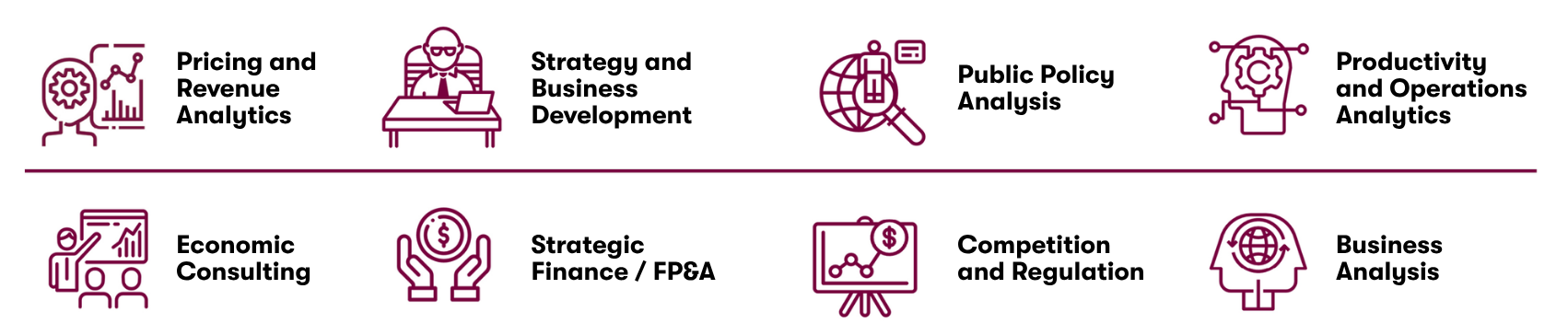
- Pricing & Revenue Analytics: demand, elasticity, margin impact, and commercial performance.
- Strategy & Business Development: market entry, competition, growth, and business-case analysis.
- Public Policy Analysis: policy impact, institutional design, and evidence-based recommendations.
- Productivity & Operations Analytics: productivity, process performance, bottlenecks, and operational value.
- Economic Consulting: economic argumentation, evidence, and client-facing analysis.
- Strategic Finance / FP&A: value drivers, forecasts, margins, risk, and performance logic.
- Competition & Regulation: market power, incentives, regulatory impact, and competition logic.
- Business Analysis: problem framing, evidence, dashboards, and decision memos.
These pathways are realistic analytical entry points, not limits on ambition. Early roles may include analyst-type positions in finance, pricing, business analysis, strategy, consulting, regulation, policy, or operations. Over time, the same analytical foundation can support movement toward broader strategic, advisory, managerial, and leadership roles.
Strategic Economics is for students who want to use economics, data, and evidence not only to describe problems, but to support decisions. With experience, this analytical foundation can become a strong asset for long-term strategic careers.
Testimonials
 We've designed the Strategic Economics program to bridge the gap between theoretical economics and strategic real-world applications. Our goal is to prepare leaders who think critically and act decisively in high-stakes environments. Based on the rigorous curriculum and the expert faculty involved, we anticipate our graduates will quickly move into roles such as Strategic Partnerships Manager or Director of Innovation, where they will apply their learning to drive significant business success.
The staff of the Strategic Economics committee.
Fee & Finances
*Annual tuition fee: 5460 Eur
Tuition fee might be postponed, but no later than December 1 in the Autumn semester and May 1 in the Spring semester; or can be payed in installments no less than 30 % of the semester tuition fee before the first month of each semester and dividing the remaining sum to one or two instalments which have to be paid before 1 December in the Autumn semester and 1 May in the Spring semester.
*Tuition fee might change insignificantly due to state regulations.
STUDENT FINANCES
More information about student finances at Vilnius University can be found here: https://www.vu.lt/en/students/services-for-students/finance

SCHOLARSHIPS
VU FEBA Admission Scholarship
Ten one-off Scholarships equal to 1000,00 EUR each will be awarded for the most motivated and competent international students applying to the Bachelor's and Master‘s programmes of Faculty of Economics and Business Administration.
The Scholarship is payable directly to the successful applicant after their arrival to study at Vilnius University Faculty of Economics and Business Administration.
Eligibility:
Candidate from any foreign country will be awarded after successful admission procedure and motivation interview to any Bachelor's and Master‘s study programme at Vilnius University Faculty of Economics and Business Administration. The ranking of best students will be made after motivation interview where students get points depending on their grades, motivation to study in Lithuania, Vilnius University and chosen study programme. If different students get same score, then grades average is compared, if also coincides the higher motivation score will be evaluated. To get the scholarship students must pay first tuition fee for their studies.
Scholarships To Get During the Study Period
All students of the University can apply for different scholarships during the study period. The way these scholarships are disbursed is stipulated by the Vilnius University Scholarship Regulations and the Lithuanian Law. More information
Incentive Scholarship – a monthly scholarship for students with excellent learning outcomes. The scholarship is granted for students every semester for the results of the previous semester – in March for the results of the Autumn semester and in October – for the results of the Spring semester.
The provided amount (60,00 EUR or 100,00 EUR) depends on the learning outcomes (the student's place in the rank of students each semester). Around 10 % of the course students get the incentive scholarship.
One-Off Social Scholarship – a scholarship, provided in the case of financial problems caused by such unfortunate events as the illness of the student or a family member, the death of a relative, natural disaster and so on. Applications for the scholarship can be filled at the eStudent environment anytime throughout the study period.
The size of the scholarship (from 80,00 EUR to 480,00 EUR) highly depends on how difficult the situation is to the applicant.
One-Off Earmarked Scholarship – a scholarship granted for students with relevant achievements in sports, cultural and scientific/social activities. The application for the scholarship with the required documents could be submitted to the eStudent environment until 25 March in the Spring semester and until 25 October in the Autumn semester.
The size of the scholarship (form 40,00 EUR to 600,00 EUR) depends on the achievements.
Nominal Scholarship – a scholarship granted for students based on certain fields of activity for their achievements or contributions in these fields. The grounds and principles of granting nominal scholarships are established in the regulations of a specific nominal scholarship and/or support agreement. Please contact the Academic Core Unit where you study to find out your options.
Social Scholarship – a scholarship (260,00 EUR) provided by the State Studies Foundation granted for students who meet at least one of these requirements:
– If they come from a family with a difficult financial situation;
– If their working ability is reduced to 45 % or more;
– If they are not older than 25 and have been granted guardianship before their full legal age.
You can only be granted the social scholarship if you as well are a citizen of a European Union (EU) of European Free Trade Association (EFTA) member country, or if you are an international student (citizen of non-EU or non-European Economic Area country) and have been granted permanent residency in Lithuania (not applicable for foreigners of Lithuanian origins).
The applications for social scholarships have to be submitted to the State Studies Foundation from the 15 September until 10 October in the Autumn semester and from 20 January until 20 February in the Spring semester. Please contact the State Studies Foundation for more detailed information.
Support for Foreigners of Lithuania
Social Scholarship – provided for students in a tender row based on the study programme and the year of studies, the form of the studies and the achievements. The scholarship (130,00 EUR) is granted each semester and is disbursed every month.
Social Disbursement – granted for foreigners of Lithuania who meet one of these requirements:
– Students of age 26 and under, whose both parents or guardians are dead (319,00 EUR);
– Students of age 26 and under, whose one of parents or guardians is dead (261,00 EUR);
– Students of age 26 and under, whose one of parents or guardians has a disability (232,00 EUR);
– Students of age 26 and under, who come from large families where at least 3 underage children or young adults (of age 26 and under) are enrolled on formal education programs (203,00 EUR).
The applications for social scholarships and social disbursements have to be submitted to the State Studies Foundation until September 30 in the Autumn semester and February 20 in the Spring semester. Please contact the State Studies Foundation for more detailed information.
State Scholarship for the Lithuanian Language and Culture Courses
Education Exchanges Support Foundation takes pleasure in offering Lithuanian state scholarships for students, lecturers and researchers of foreign countries to attend Lithuanian language and culture courses.
More information.