

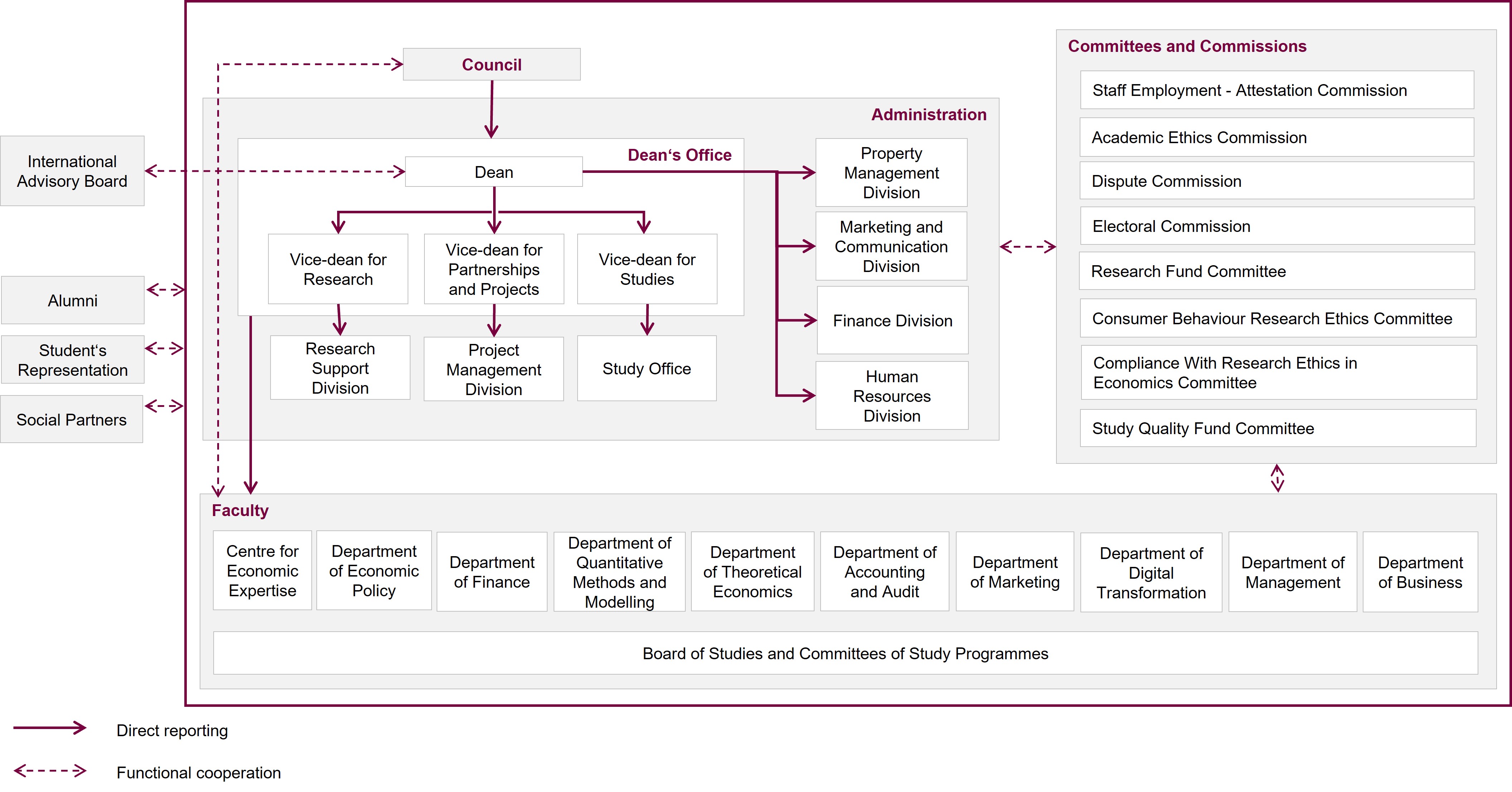
The Faculty of Economics and Business Administration of Vilnius University (VU FEBA) applies the principle of shared governance, which ensures that the faculty community is not only informed about key decisions but also actively involved in the decision-making process.
The faculty structure consists of governing bodies, academic units, and administrative departments, each of which performs clearly defined functions and contributes to the organisation and quality of studies, research, and the day-to-day activities of the faculty.
The main self-governance body of the faculty is the Faculty Council. It is a collegial body elected for a four-year term and includes representatives of academic staff, students, non-academic staff, social partners, and the Dean. The Faculty Council approves the candidacy of the Dean, considers and approves strategic and operational plans, reviews annual activity reports, establishes academic units, appoints their heads, and contributes to the development of study programmes.
The faculty is headed by the Dean, who is accountable to the Faculty Council and the Rector of the University. The Dean is elected for a five-year term and may serve no more than two consecutive terms. The Dean ensures the strategic direction of the faculty, oversees compliance with legal acts and university regulations, ensures the quality of studies and research, manages the faculty’s resources, and implements strategic objectives. The Dean also submits proposals on academic and strategic matters and represents the faculty in university governance processes.
In day-to-day activities, the Dean is supported by the Dean’s team, which provides advice and coordinates the key areas of the faculty’s activities. The team consists of the Vice-Dean for Studies, the Vice-Dean for Research, and the Vice-Dean for Partnerships and Projects. The Vice-Deans and the units under their supervision ensure the smooth operation of the faculty and are responsible for the quality of activities within their respective areas of competence. When necessary, the Dean, together with the Dean’s team and the Chair of the Vilnius University Students’ Representation at the faculty, discusses relevant issues.
Academic units carry out the faculty’s core activities: studies, research, and expert activities. At present, the faculty consists of nine departments and one centre. These units create and develop study programmes, conduct research, train specialists, and contribute to the dissemination of knowledge and the development of innovation.
Administrative units form an important part of the faculty’s operations by ensuring the effective organisation of studies, research, and other processes. The faculty’s administrative structure consists of the Studies Office, Research Support Division, Project Management Division, Finance Division, Property Management Division, Human Resources Division, and Marketing and Communications Division. The activities of these units help ensure the smooth functioning of the faculty by providing support to students, staff, and external partners.
The faculty also has various commissions and committees that contribute to governance, quality assurance, and compliance with standards of academic ethics. The Academic Staff Selection and Appraisal Commission organises the selection and evaluation of academic staff and ensures compliance with qualification requirements. The Academic Ethics Commission examines potential violations of academic ethics, while the Dispute Resolution Commission resolves disputes and appeals related to studies and assessment. Elections to the Faculty Council, for the Dean, or other elections are organised by the Election Commission. The Research Fund Committee allocates funding for research activities. The Study Quality Fund Committee allocates funding for activities aimed at improving the quality of studies. Research ethics committees ensure that research in economics and consumer decision-making is conducted in accordance with the highest ethical standards.
The quality and continuous improvement of study programmes are overseen by study programme committees and doctoral committees. They regularly evaluate the content of study programmes, analyse feedback from students and social partners, monitor quality indicators, submit proposals for programme improvement, and report annually to the Faculty Council. The Study Board also contributes to improving the quality of studies by advising the Vice-Dean for Studies on the development of study programmes, quality assurance, teaching workload planning, and other academic matters. The Board consists of the chairs of study programme committees and a representative of the Vilnius University Students’ Representation at the faculty.
This governance and organisational structure ensures transparent decision-making, responsible resource management, high quality of studies and research, and the continuous improvement of VU FEBA’s activities.